
Patients that talk back
Natural spoken conversation with an AI patient who stays in character, answers what you actually asked, and can cut across you the way a real one does.
Clinical exam preparation
Run timed clinical stations, speak with an AI patient who answers in character, and get structured feedback on every consultation you give. Built for the PLAB2 examination.
ClinicalVitals is an independent exam-preparation platform and is not affiliated with or endorsed by the General Medical Council. Full disclaimer
Example scorecard
4 clinical stations
Across 2 disciplines
Independent practice tool
Not affiliated with or endorsed by the General Medical Council
Flexible and self-paced
Up to 20 stations per rolling 24 hours
How it works
Three steps, on the clock the exam runs on.
90 sec reading+8 min consultation=9 min 30 sec
You have 90 seconds with the candidate instructions, as in the exam.
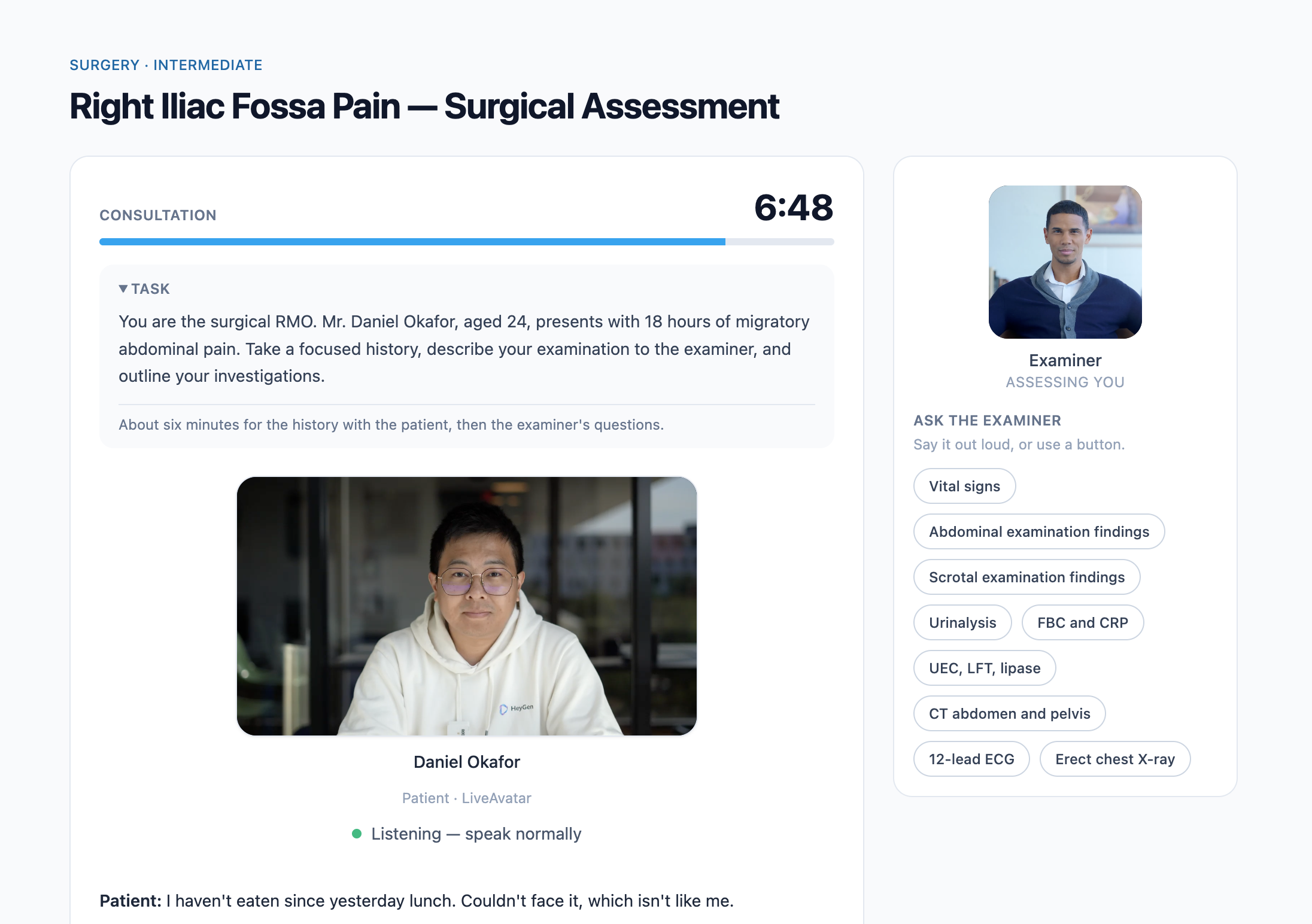
8 minutes of spoken consultation with an AI patient who answers in character and can interrupt. Ask the examiner for findings and investigations and they answer aloud.
A score and comment on every category, the misses that mattered, any safety concerns, and a spoken walkthrough of the station performed to a high standard.
Try a free station

Angela Whitaker, 60, female. She speaks clearly and initially sounds brisk and eager for reassurance. After hearing about the unexpected finding, her voice becomes quieter and hesitant, and she asks direct questions about cancer and whether she might lose her breast. She answers openly when asked and appreciates pauses and checks of understanding..
You'll need a microphone and a quiet room.
What you get
3 minutes with the patient
No account needed. Spoken, timed, and marked for real.
Your score, straight away
Pass or fail, what went well, and the first thing to fix.
The full report, with a free account
Every category scored, with notes against the lines you said.
Your feedback
Every result explains itself. Pick a part of the scorecard to see what it does.
See the full example scorecardAn example, not a real candidate’s result.
Acute Chest Pain, Emergency Department
Not a pass yet. You’re two marks away.
Just below the standard · A station passes at 8 of 12
By category
Dashed line: pass mark
Your consultation
Patient: I have been having chest pain for the last few hours.
You: Can you tell me more about the pain?Missed
Try: “Does the pain go through to your back at all, and did it come on all at once?”
Patient: It is a tightness, mostly in the centre of my chest.
Why ClinicalVitals
Natural spoken conversation with an AI patient who stays in character, answers what you actually asked, and can cut across you the way a real one does.
90 seconds reading, then 8 minutes consulting, with a chime at one minute left. The clock runs against a real deadline and cannot be paused.
Not just a number. Every category is scored and commented on, and each miss comes with why it mattered and the words you could have used.
Sit a station again whenever you want and watch the same categories move. No study partner to schedule, and no waiting for a tutor.
Pricing
Every pass is a single payment for a fixed period. Nothing renews, and there is nothing to cancel.
20-day refund
Not what you expected? Ask within 20 days of purchase and we refund the pass.
See how it works before you pay anything.
£0No credit card
Last-minute, intensive preparation.
£35one payment
14 days
The full run-up to the exam.
£99one payment
3 months
Add a human review
Optional, on any station you choose.
£25per station
Questions about a pass? Use the contact button in the corner of any page. Full pricing details
Example station
What comes back when the time is up, shown here as an invented result for Acute Chest Pain, Emergency Department.
Feedback refers to
Before you start, every station shows
Did not ask whether the pain tore through to the back.Missed
Why it matters
Tearing pain through to the back is the question that separates a dissection from a heart attack.
Try saying
“Does the pain go through to your back at all, and did it come on all at once?”
No safety-netting before the patient was sent home.Missed
Why it matters
The patient leaves without knowing what would make this an emergency.
Try saying
“If the pain comes back or you feel breathless, call an ambulance straight away.”
The mock circuit
The whole exam, end to end: 16 stations back to back over three hours, with no marks until it is over. It shows you how your consultations hold up at station sixteen compared with station one.
Every station is scored. Two rest stations break it up, and nothing else does.
A pass is 10 of the 16 stations and 120 of the 192 marks.
Those two numbers are ours, not the examiner’s. The real exam sets its bar for each sitting from how that sitting’s candidates performed, and does not publish a fixed one — so this is our steady approximation of it rather than a figure you can hold the exam to.
No marks until it is over, and rest stations cannot be skipped. Circuits need a pass and use sixteen stations of your 24-hour limit.
Human review
£25 per station, requested from your scorecard, usually returned within 5 days. A ClinicalVitals reviewer reads the whole transcript and marks it again on the same rubric.
Human review is educational feedback and is not official GMC marking. The reviewer is not an examiner of record for any examining body.
The feedback
You speak with the simulated patient for the length of the station.
Speech-recognition software converts the conversation into a written transcript, which you can read afterwards.
A language model evaluates the transcript against the ClinicalVitals feedback rubric for that station, with reference to current clinical guidelines.
A score and comment per category, strengths, misses, any safety concerns, and notes against specific lines of the transcript.
AI-generated feedback can occasionally be incorrect or incomplete. ClinicalVitals is a practice tool, not an official GMC examiner. If a mark looks wrong, the problem button on the scorecard tells us.
Full-duplex audio: you can cut in and redirect as you would in the room, and the patient can do the same. Each station keeps the same patient voice every time you sit it.
90 seconds reading, then 8 minutes consulting, with a chime at one minute left. The countdown runs against a real deadline and cannot be paused.
Ask for examination findings or investigations and the examiner answers aloud. There is no closing viva, matching the PLAB 2 format.
ClinicalVitals assesses the content and structure of your consultation, not whether you sound like a native English speaker. Speech recognition can occasionally produce transcription errors, so transcript-based feedback should be read with that limitation in mind.
These are ClinicalVitals practice and feedback categories, designed around the three skill areas the PLAB 2 examination assesses. Each is scored 0 to 4. They are not an official the GMC scoring system.
Who built this
ClinicalVitals is a small independent product. It was built by an international medical graduate who prepared for and sat PLAB 2, and who wanted a way to practise consultations out loud, against the clock, without needing a study partner available at the same hour.
The stations are drafted, edited and approved by the founder. How that is done, and what is and is not checked, is set out in the full disclaimer.
Questions
In short
One full station, free, with feedback and a transcript — read your own result before deciding anything. £99 then opens every station and the mock circuit for 3 months.